Is Stripchat Legal in India? Laws & Key Questions
There is no useful blanket answer to “is Stripchat legal in India?” without first asking what someone plans to do. An adult opening a page, a person forwarding a recording and a performer broadcasting from India are doing different things. The legal questions change with the content, the activity and the people involved.
India has laws addressing electronic obscenity, sexually explicit publications, child sexual abuse material and violations of privacy. A website being available in your browser does not settle how those laws apply. Equally, a failed connection does not by itself establish that visiting the website is a criminal offence.
For readers deciding whether to use Stripchat, the key distinction is between accessing content and creating, publishing or passing it on. For anyone planning to broadcast or run a related business, that distinction deserves attention before an account, payment arrangement or website goes live. Our Stripchat India review covers the service itself; this page looks at the legal questions behind its use.
Start with the activity you are considering
A discussion about adult websites can become misleading when it treats every kind of participation as the same. Use this table to identify the question that actually concerns you.
| Activity | The question to examine |
|---|---|
| Privately viewing adult content | What is the nature of the material, and does the activity remain personal viewing? |
| Buying tokens or tipping | What is being paid for, and what rules apply to the underlying activity? |
| Recording or forwarding a stream | Do you have the necessary rights and consent, and are you distributing prohibited material? |
| Broadcasting from India | What laws apply to the content you create and transmit? |
| Publishing an independent review | What are you publishing, reproducing, linking to or allowing visitors to upload? |
| Encountering material involving a child | What child-protection offences and reporting procedures apply? |
The name of the platform cannot answer all these questions. Neither can the fact that a performer agreed to appear, that a room requires payment or that a website is operated abroad. Each fact may matter, but none is a general permission to ignore applicable law.
What the IT Act says about online adult content
The Information Technology Act, 2000 draws distinctions between different kinds of electronic material and conduct. Section 67 concerns publishing or transmitting obscene material electronically, including causing its publication or transmission. It uses a statutory obscenity test; it does not simply make the name of an adult website the test of an offence.
Section 67A addresses publication or transmission of material containing sexually explicit acts or conduct. The text of Section 67A, reproduced on a government website, provides for imprisonment of up to five years and a fine of up to ₹10 lakh for a first conviction. The maximum imprisonment increases to seven years for a subsequent conviction, with a fine of up to ₹10 lakh.
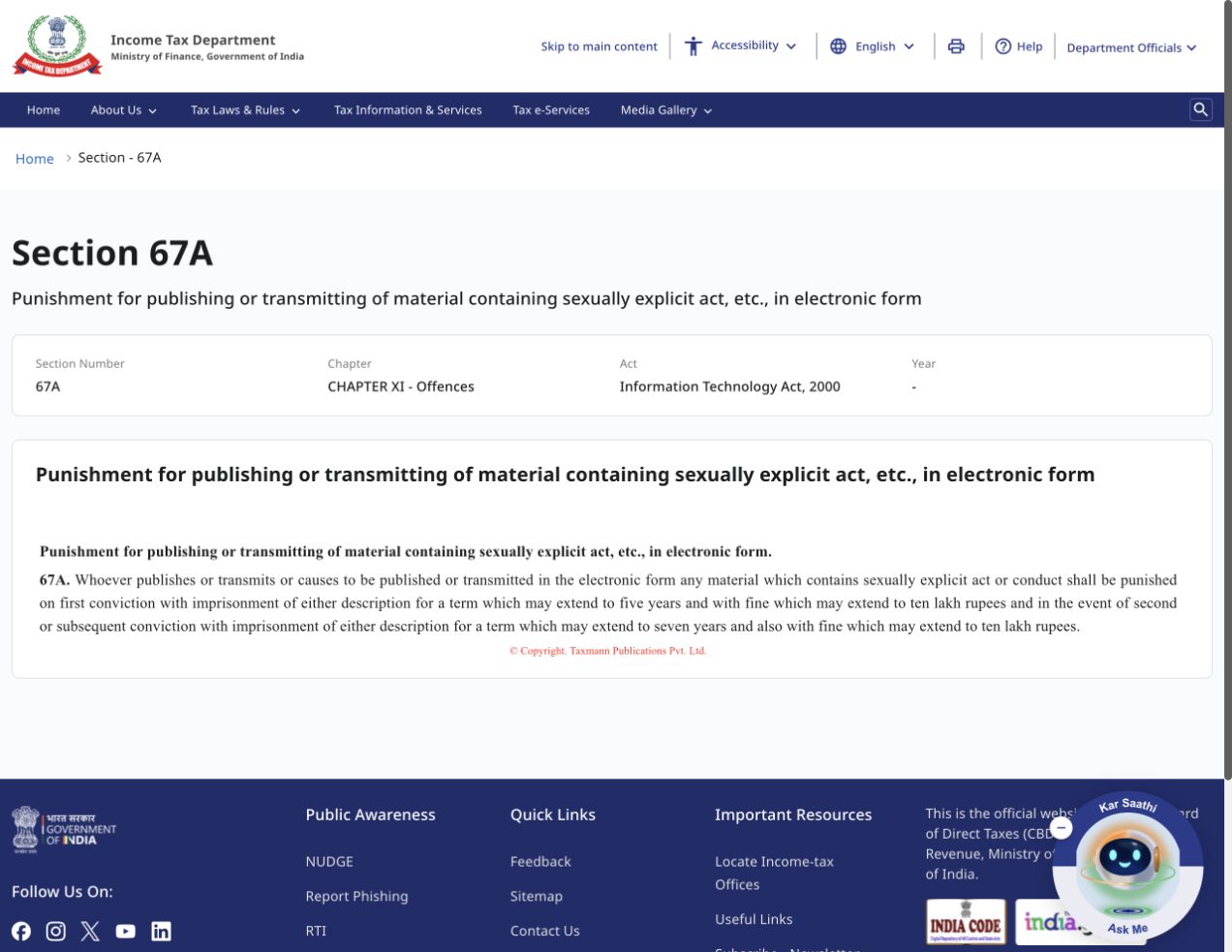
These provisions make the act of sending or publishing important. Calling something a personal account, a private room or a subscriber-only post does not, on its own, remove the question of transmission under Section 67A. Nor does consent between adults create a general exception to that section. The exact facts and any applicable statutory exception still need to be examined.
There are also laws beyond the IT Act. A government statement on restrictions affecting online platforms identifies Section 294 of the Bharatiya Nyaya Sanhita, 2023, alongside Sections 67 and 67A and the Indecent Representation of Women (Prohibition) Act. Advice that discusses only old IPC section numbers may therefore miss the current framework. A serious assessment of a publishing or broadcasting business should consider the relevant laws together.
Is privately watching Stripchat the same as publishing?
No. Reading a document, viewing a stream and sending a recording to other people describe different actions. The publication and transmission language above should not be turned into a claim that every adult who opens an adult website has committed the same offence as its publisher. It also should not be stretched into a promise that everything available through that website is lawful to access.
Consider how quickly an activity can change. Someone may start by viewing a room, then record it, post an excerpt to a social account or send the file to a group. At that point, “I only watched it privately” no longer describes the whole situation. Who received the material, what it contains and how it was obtained become relevant questions.
Avoid relying on slogans such as “all adult content is legal in private” or “every adult website is banned.” They conceal precisely the details that matter. In particular, material involving children belongs to a different legal category, and non-consensual intimate images raise additional concerns. A platform’s adult branding cannot establish the age or consent of everyone depicted in a particular file.
For an individual reader, a sensible boundary is to avoid turning access into redistribution. Do not assume a recording becomes yours to circulate because you paid to watch it. If a dispute involves a particular file, message or police notice, an Indian lawyer needs those facts rather than a general description of the website.
Buying tokens does not establish legal permission
A successful payment tells you that a transaction was processed. It does not certify the legal status of everything you might request, receive or publish afterwards. The same applies to a payment method appearing in a help article: it is information about payment arrangements, not approval from an Indian regulator.
This distinction is particularly useful when comparing claims on review and affiliate websites. “Indian users can pay” and “all uses are lawful in India” are separate claims. The first needs evidence about the actual checkout and country-specific availability. The second requires an assessment of the activity and applicable law. One cannot substantiate the other.
Keep the financial decision separate too. Before paying, understand the amount, currency, billing terms and refund conditions presented for your purchase. Do not interpret a bank declining a transaction as a legal ruling, or a bank accepting it as permission to publish explicit material. For the account and payment risks that sit alongside these questions, see our Stripchat safety review.
Broadcasting from India raises different questions
Becoming a performer is a materially different decision from browsing a public page. A broadcaster creates content and sends it to other people. A studio, account manager or business that organises broadcasts may introduce further responsibilities. The legal analysis needs to follow those actual roles.
A platform approving a creator account does not determine whether a planned broadcast complies with Indian law. Identity checks and platform content rules have their own purposes. They do not replace an assessment of the material being transmitted, where the activity takes place or how other participants are involved.
Several common assumptions are unreliable:
- Everyone is an adult. Age is essential, but it does not resolve every restriction on sexually explicit publication.
- Everyone consented. Consent matters, yet it is not a general exemption from obscenity or publication laws.
- Only one paying viewer can see it. A small audience does not remove the need to examine transmission.
- The platform is overseas. The operator’s location does not answer every question about a person broadcasting from India.
- The platform approved the account. Approval is not a legal opinion on the creator’s activities.
Before beginning a broadcasting or studio business, obtain advice from an Indian lawyer about the proposed content and operating arrangements. Describe what will actually be transmitted and by whom. A discussion based only on the phrase “online modelling” can miss the facts that determine the legal risk.
What Stripchat’s own terms require
Stripchat’s terms of use require users to be at least 18, or older where the applicable age of majority is higher. They also prohibit use where it is unlawful. Those are meaningful eligibility conditions, but they do not provide an India-specific legal clearance.
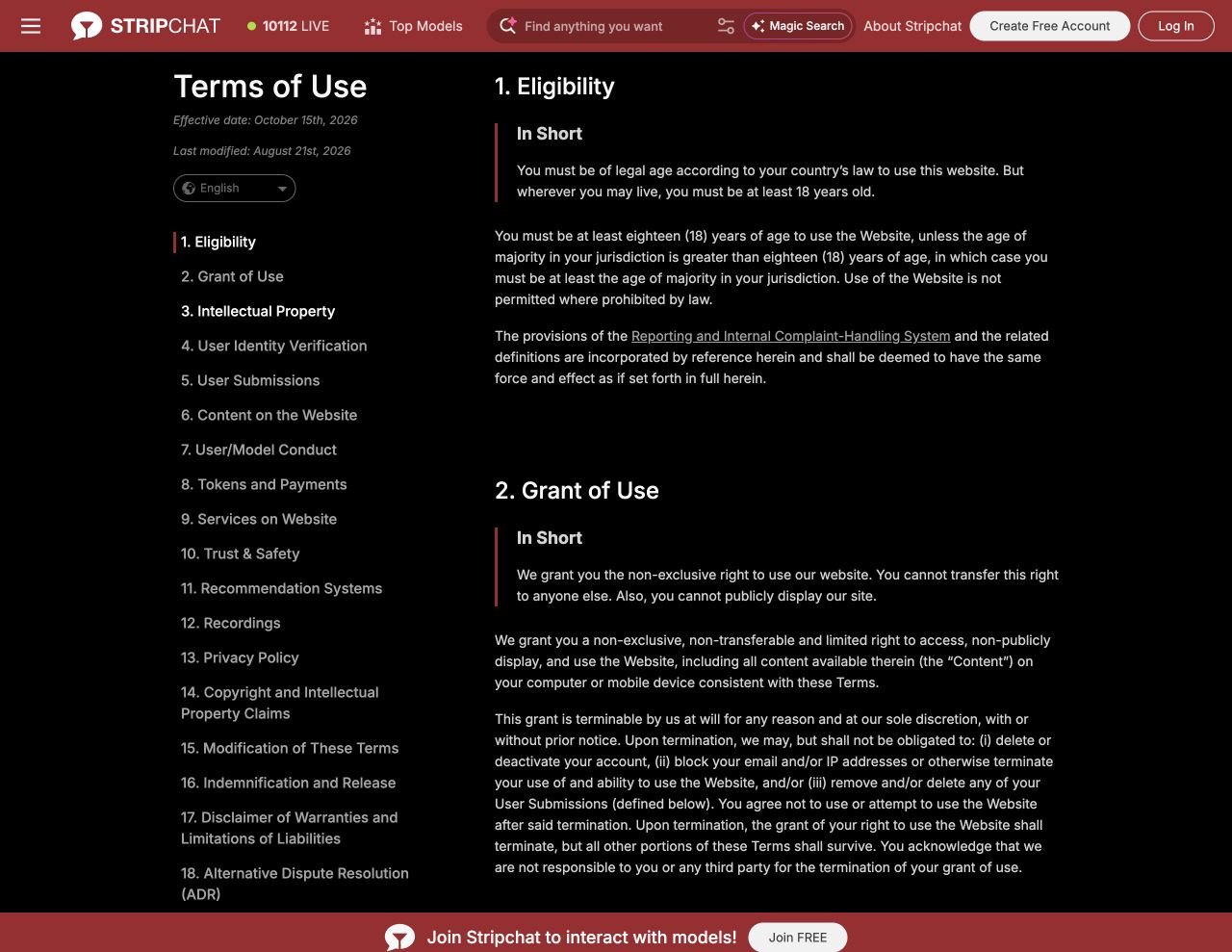
The local-law condition is easy to overlook. It means the platform’s own permission to use an account is conditional. Agreeing to the terms cannot make a prohibited activity lawful, and being able to register does not establish that every feature is appropriate for your circumstances.
For the practical account and billing implications, see Stripchat terms explained. The terms also address rights in the site’s content. Access should not be confused with ownership of streams, photographs or interface materials. A viewer planning to repost something and a publisher planning to illustrate a review both need to consider what they are reproducing and why.
Material involving children is a separate legal category
The rules for child sexual abuse material cannot be inferred from discussions of private adult viewing. Section 67B of the IT Act reaches conduct beyond publication, including specified acts of seeking, browsing and downloading child sexual material. POCSO also addresses possession or storage in circumstances defined by its provisions.
In Just Rights for Children Alliance v. S. Harish, the Supreme Court examined Section 67B and Section 15 of POCSO. The judgment explains why the analysis cannot stop at whether a file was saved to a device: knowledge and control can matter to constructive possession. It also distinguishes offences under Section 15 by their statutory requirements, including the relevant intent. This is not a rule that every accidental appearance of an image is automatically the same offence.
Do not seek, save or forward such material. If suspected abuse appears, stop interacting with it and use the appropriate reporting channel. Reporting should not become a reason to circulate the content or create additional copies. A URL and the surrounding circumstances can identify a concern without republishing the material to friends or a public group.
The practical point is clear: a website describing itself as adults-only is not a reason to ignore suspected child exploitation. Treat the specific content seriously rather than assuming the site’s branding settles the issue.
Is Stripchat banned or blocked in India?
A claim about blocking needs evidence identifying the affected service or domain and the scope of the restriction. General news about adult platforms is insufficient to establish the status of Stripchat specifically. A search result saying “adult sites banned” may refer to another service, an older action or a particular list of URLs.
For example, a government announcement about online-content restrictions says that 50 OTT platforms were disabled over two years for obscene content under the relevant laws. That announcement illustrates enforcement against online services. It does not identify Stripchat, so it does not establish a Stripchat-specific ban.
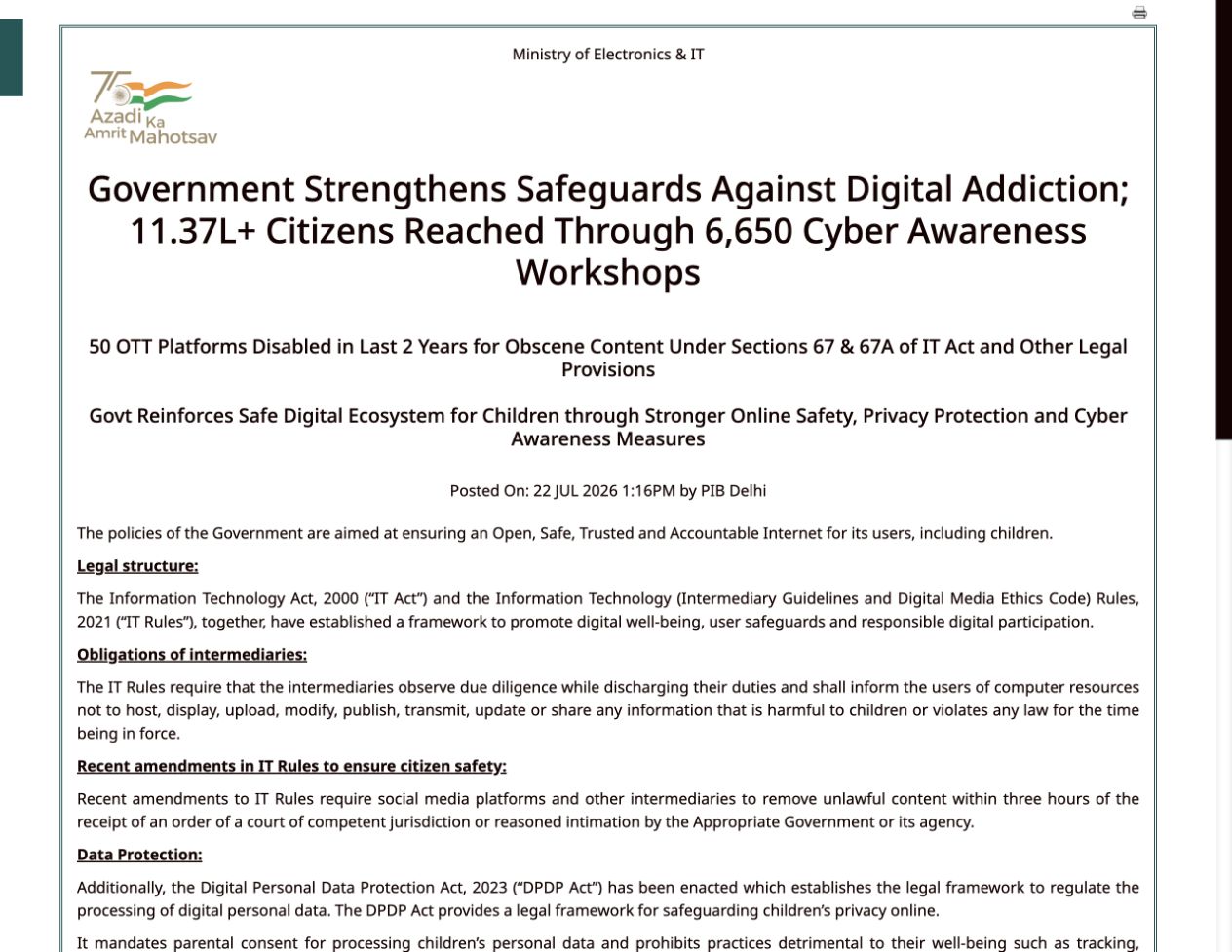
There is also a difference between a restriction affecting access and the elements of a criminal offence. A browser error alone cannot tell you which is involved. It may reflect a network problem, a provider restriction or a service issue. Conversely, successful access is not a statement from the authorities that every activity on the site is permitted.
If a restriction notice appears, read what it actually identifies. Changing the route used to reach a website does not change the legal character of the content or your conduct. Technical access and legal permission remain separate questions.
Can you run an independent Stripchat review website?
Publishing original commentary about a service differs from hosting its streams. A useful review can explain navigation, account controls, pricing arrangements and support without distributing explicit recordings. The publisher still needs to assess the text, images, links and features that make up the finished website.
The practical approach is to make the review itself do the work. Explain what a setting means, analyse a payment condition or compare the information a user receives. Do not use “review” as a label for a page whose main purpose is to reproduce someone else’s content. Adding a paragraph above a collection of recordings does not settle the legal position.
Screenshots and copyright
A screenshot is a reproduction, so its purpose and extent matter. In TV Today Network v. News Laundry Media, the Delhi High Court explained that fair dealing for criticism or review depends on the facts. The court emphasised genuine analysis and use limited to what the critique requires; another person’s work should not simply be used to make a publication more attractive.
For a service review, choose an image because it supports a specific point, such as showing the wording of an eligibility rule. Explain that point in the surrounding text. Prefer a relevant interface or policy excerpt over a performer’s image when the interface or policy is what you are discussing. Attribution is useful, but credit alone does not establish permission or fair dealing.
Copyright and content restrictions are separate questions. An image might be relevant to criticism while still raising privacy or unlawful-content concerns. An age gate or a short caption does not resolve those concerns.
Comments, uploads and embedded content
A site with only its publisher’s original articles has a different operating model from one that hosts visitor uploads or comments. If visitors can submit material, consider how it is reviewed, reported and removed. If a page embeds a third-party player, assess what that player actually delivers rather than treating the embed as harmless decoration.
The IT intermediary rules, as amended, contain obligations for services falling within their scope. Whether a particular feature makes the operator an intermediary, and whether a protection is available, needs a functional assessment. Simply calling a website an independent review does not answer that question.
Before adding uploads, live players or a commercial relationship involving content distribution, review the resulting business with an Indian lawyer. The question is what the website enables and publishes, not merely what appears in its footer.
Frequently asked questions
Does being over 18 make every use of Stripchat lawful in India?
No. Meeting an age requirement addresses one eligibility condition. It does not settle restrictions on publication, privacy, copyright or the nature of particular content. Adult consent also does not create a blanket permission to publish sexually explicit material.
Can I share a recording in a private messaging group?
Do not assume that a closed group makes redistribution lawful. Sharing creates a new activity to assess, involving the material itself, the rights of the people depicted and your permission to reproduce it. Paying for access is not the same as acquiring distribution rights.
Does a token payment prove the service is approved in India?
No. Payment processing and legal approval are different things. A completed purchase does not certify the lawfulness of a broadcast or a later request, and an advertised payment method does not amount to regulatory endorsement.
Does using a VPN change the legal position?
Changing a connection does not change what you publish, transmit or access. It therefore cannot serve as a general answer to the legal questions on this page. A technical tool should not be mistaken for permission to engage in prohibited conduct.
Is an adult website review automatically exempt from copyright rules?
No. A genuine review can raise fair-dealing arguments, but the assessment depends on the actual use. Relevant, limited illustrations with original analysis are different from republishing content mainly to attract visitors. Other content and privacy laws must also be considered.
What should I check before making a decision?
Identify the activity first: personal viewing, payment, redistribution, broadcasting or publishing a review. Then examine the content and rules relevant to that activity. If the decision concerns starting a business, distributing recordings or responding to an official notice, obtain advice on those concrete facts before proceeding.