Stripchat Payment Declined in India
A declined Stripchat payment can have several causes: incorrect card details, insufficient available funds, a transaction limit, or restrictions imposed by the issuing bank. For an Indian card, international online-payment permission is another point to check. A “transaction failed” message alone does not identify which part of the purchase refused or failed to complete it.
Start by checking whether the attempted payment is pending, completed or absent from the bank or provider’s records, and whether tokens were credited. Once that is clear, you can investigate the reason for the refusal without accidentally creating more purchases.
This guide takes you through that process, including what to ask the bank, when Stripchat support can help, and why changing cards or trying UPI is not a universal solution.
What to check before trying again
Keep the checkout message and the approximate time of the attempt. Then look at the payment record and Token History. A screenshot of an error can be useful, provided it does not contain card details or an authentication code.
| What you see | What to check next |
|---|---|
| A decline message and no visible bank entry | Card details, available funds, relevant usage permissions and limits; ask the issuer whether it received the attempt. |
| A bank entry marked pending but no token credit | Ask the bank or provider what the entry represents before submitting another purchase. |
| A completed payment but no token credit | Keep the receipt and provider reference, then investigate token delivery with the provider and platform support. |
| A token credit in history but an unexpected balance | Ask support to reconcile the credit and subsequent account activity. |
| A failed or unfinished authentication step | Check the issuer’s message and instructions through its genuine banking interface. |
| A notice that purchases or spending are disabled | Follow the account-specific support or verification instructions. |
This first check saves time. A pending payment needs a status explanation; a card-category restriction needs the issuer’s explanation; a platform account restriction needs the platform’s attention. Repeating the same purchase does not distinguish between them.
Why Stripchat card payments can be declined
Stripchat’s general decline guide identifies incorrect details, insufficient funds and issuing-bank restrictions as possible causes. It also notes that banks may block international transactions or an unusual frequency of online transactions for security reasons.
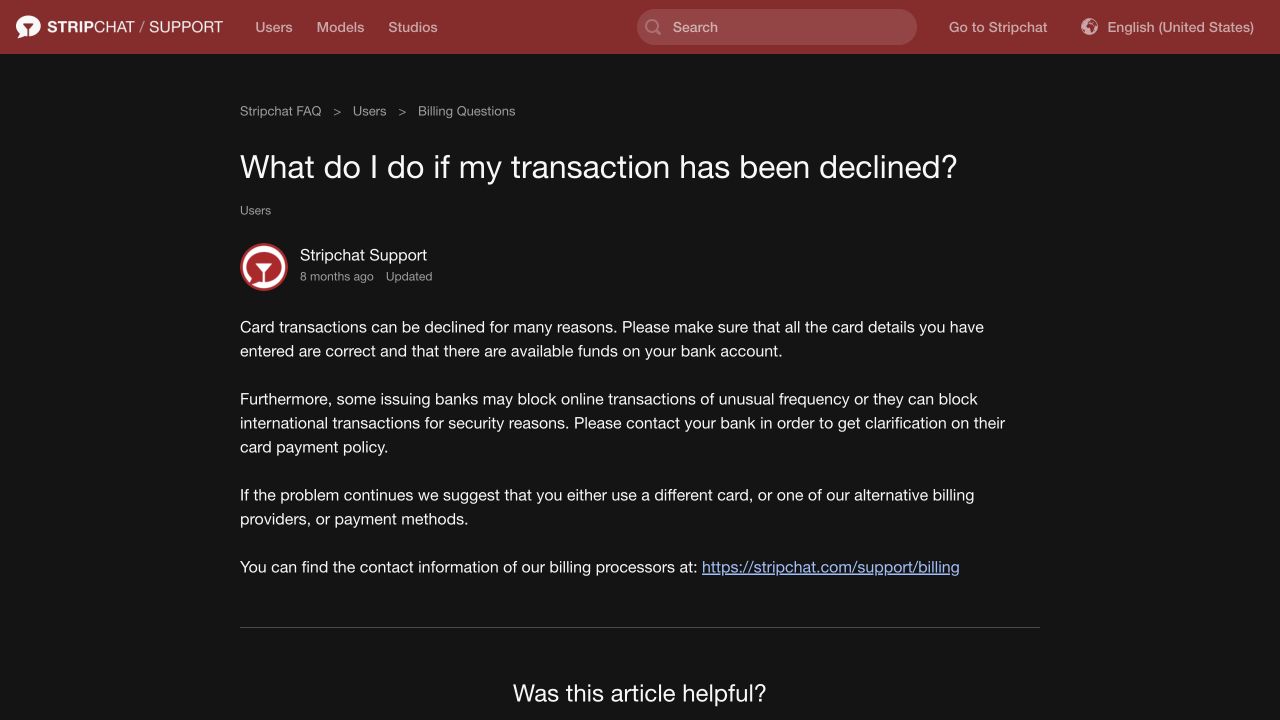
These are possible explanations, not a diagnosis of your account. A refusal that happens after a successful purchase last week may still need investigation. The relevant balance, settings, limits and transaction circumstances can differ from one attempt to the next.
Incorrect or outdated card details
Check the details you entered against the card you are authorised to use. An expired card, a replacement card or an old saved payment record is worth noticing before asking support to trace a purchase. Follow the provider’s instructions for any billing information it requests and keep that information accurate.
Make corrections only in the genuine checkout. Support does not need your CVV, PIN or a one-time password in an email or chat message to discuss the error. If a stranger offers to “fix” the decline by collecting those details, use the bank or platform’s own support route instead.
Available funds and the full purchase amount
Check the funds or credit actually available for the attempted payment. The amount you intend to spend is the full purchase total, not the price of one token or one minute of a future session.
If the package is quoted in another currency, distinguish that quoted amount from its eventual rupee cost. Your issuer can explain the amount it attempted to authorise and any relevant fees. A rough currency conversion is useful for planning, but it is not the bank’s payment record. See our Stripchat token-price guide in INR for the cost components to compare.
Issuer restrictions and repeated attempts
A card can be accepted as a payment category by a website while a particular payment is refused by its issuer. Ask the bank about the actual attempted transaction, rather than asking only whether the card generally works online.
Repeated attempts can also make the records harder to read. If several requests were submitted, note their individual times and check the status of each. Do not assume several notifications mean several completed charges, or that every failed-looking attempt has disappeared from the payment system.
International online payments and Indian cards
Stripchat’s India-specific decline article points users towards checking international online-payment capability. The useful question for your issuer is whether the attempted payment is permitted on your particular card and which usage category it falls under.
As a concrete issuer example, SBI Card’s usage-and-limits FAQ explains that an operation is declined when its transaction-category switch is off. It also says a category limit can cause a decline even when the overall credit limit is sufficient. These are separate checks from the general availability of credit.
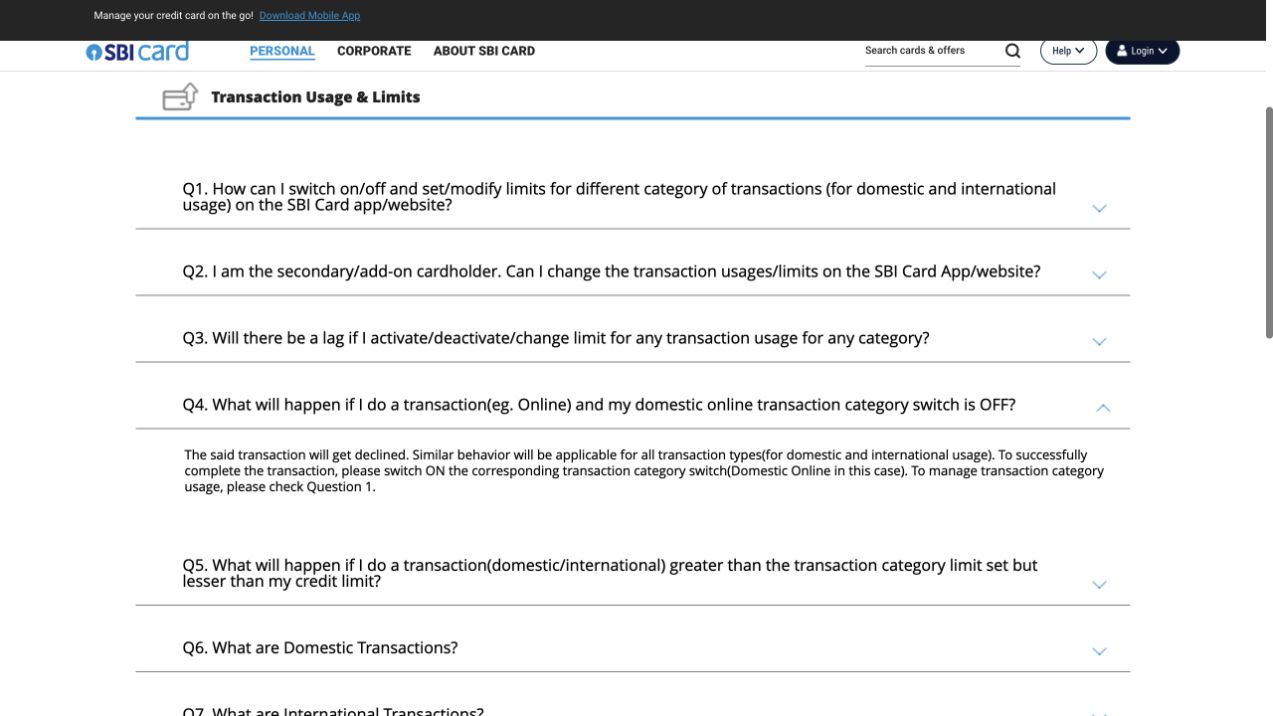
Look at your own issuer’s controls and ask it to explain the relevant setting or limit. A purchase displayed in rupees should not, by itself, be used to decide which bank permission applies. Give the issuer the actual transaction details so it can identify the payment correctly.
Use settings that fit the purchase you deliberately intend to make and the risk you are comfortable with. There is no need to raise every limit to its maximum. A permission being enabled also does not guarantee approval by the issuer or the payment processor.
Does every Indian card need to be replaced?
Do not assume so from a generic error. Ask the issuer what your existing card supports and whether a setting, product restriction or another issue explains the result. Any need for a replacement card, a different product or an application process depends on that issuer and card.
There is no single activation timetable that applies to all Indian banks. Use the bank’s own instructions and confirmation rather than assuming that a particular number of hours will resolve every international-payment problem.
What if the OTP or authentication step failed?
Note where the process stopped: before the banking prompt appeared, while confirming it, or after returning to the payment page. Record the message shown and check for a final bank or provider status. Completing an authentication prompt is not the same record as the final purchase confirmation and token credit.
If an expected message did not arrive or a prompt expired, ask the issuer about its authentication process and the specific attempt. Do not keep requesting codes and resubmitting payments without knowing what happened to the earlier attempt.
Enter authentication information only in the genuine bank or payment interface. Never send a code to a model, a supposed agent or a support chat participant. A legitimate question about a decline can be investigated using the transaction details without handing over access to your banking account.
Money was debited but the payment page said failed
A checkout error and a banking entry need to be reconciled. The presence of a debit notification does not tell you, on its own, whether the entry is a temporary hold or a completed purchase. Ask the bank or provider to identify its status.
Stripchat’s missing-tokens guide starts with Token History. If there is no token credit, it directs users to confirm payment status with the bank or provider. For card and PayPal payments, it distinguishes a recorded token credit from a likely failed purchase or funds on hold.
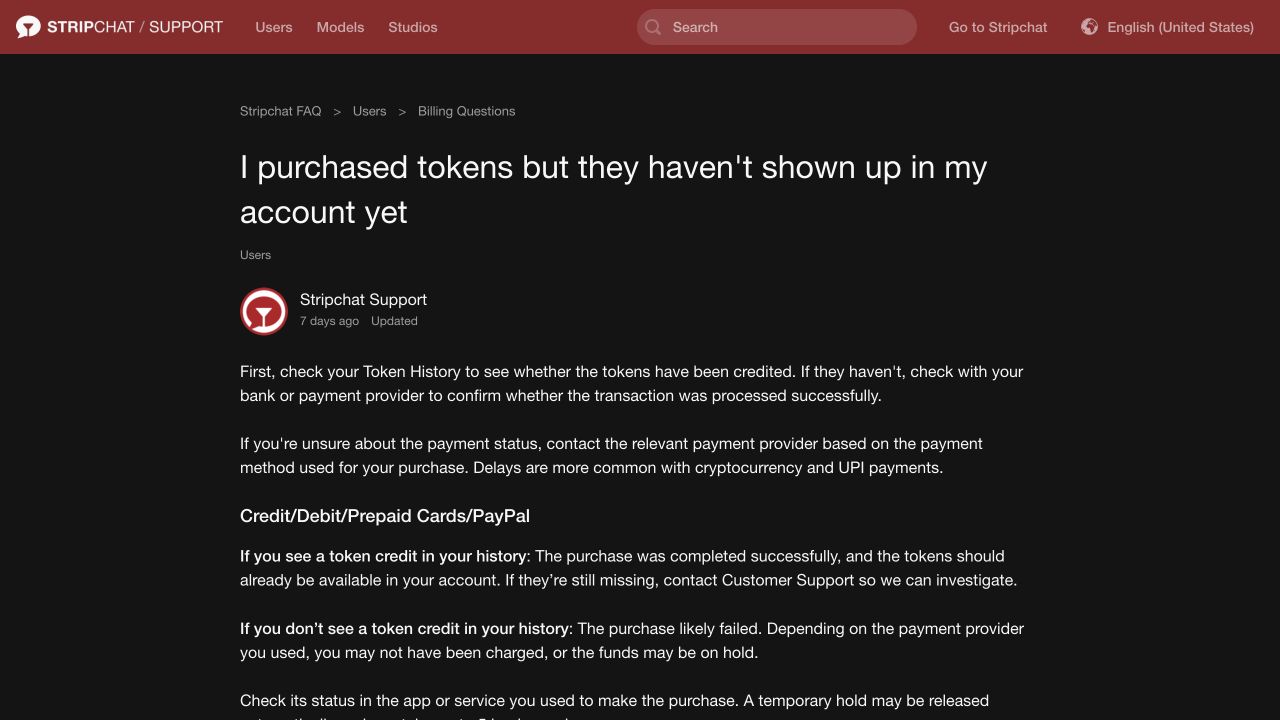
If Token History shows the credit but the tokens are unavailable, contact Customer Support with that information. If there is no credit, keep the receipt or provider reference and establish whether the payment completed. Explain any mismatch between the provider’s answer and the account history.
Our Stripchat tokens not received guide explains the method-specific follow-up and the records to send when a payment and token credit do not match.
The help guide gives method-specific instructions; its examples are not a promise that every debit will be returned on one universal schedule. Ask the relevant provider what its status means and what follow-up applies. Suspected unauthorised use is a separate matter to report promptly to the bank.
For unfamiliar billing names or possible duplicate entries, our bank-statement guide explains how to compare the descriptor, amount, currency, date and reference. If the issue becomes a request to return a completed purchase, use the separate refund guide.
A purchase restriction on the Stripchat account
Sometimes the relevant message concerns the site account rather than the card. If purchases or token spending have been disabled, changing the bank card does not establish that the restriction has been resolved.
Stripchat documents account verification for restoring certain purchasing or spending access. Follow the instructions presented for your account through the official site. Our verification guide explains the difference between account, document and card-ownership checks.
Keep a bank decline and a platform restriction separate in your support request. Include the exact wording of the notice. Do not pay an intermediary who claims they can remove a restriction or use another person’s identity to get around it.
Should you try another card or UPI?
The general decline article suggests another card or an alternative payment route if the issue continues. That is useful only after the earlier attempt’s status is clear and the new route is actually offered to your account.
Use a payment method you are authorised to use, with terms and costs you understand. A different card is not evidence that the first card’s restriction was mistaken, and it is not a guaranteed way to obtain approval. Respect a bank or provider’s decision about what it permits.
UPI is a different payment route from a card transaction. Its appearance in Stripchat’s general documentation does not establish availability for every Indian checkout, and a card’s online-payment setting does not diagnose a UPI failure. Use the provider and transaction reference for the method you actually selected.
The payment-methods guide for India covers the documented alternatives and the country-availability qualification. Check the live choices before obtaining a voucher, opening another account or sending money. Avoid unofficial sellers who promise guaranteed tokens or ask you to transfer funds outside the offered purchase process.
Who can explain the decline?
The most useful support contact is the one responsible for the part that needs clarification. Keep the same transaction details available when moving between the bank, provider and platform.
Ask the bank about its decision and record
Give the date, approximate time, amount, currency and merchant or provider descriptor. Ask whether it received the attempt, what status it recorded, and whether a usage permission, limit, authentication issue or issuer policy explains the refusal.
Provide accurate information if the bank asks about the merchant or purpose. An unfamiliar provider descriptor should be described as it appears, along with the actual purchase you attempted. The goal is an explanation of the transaction, not a different story to make it pass.
If the issuer did not receive the attempt, relay that finding to the payment provider or platform support. It narrows the question, although it does not by itself prove the exact cause elsewhere in the purchase flow.
Ask the provider about payment processing
Use the provider identified in the checkout or receipt and the official support route associated with it. Ask about the existing attempt using its reference. Be clear whether you need a status explanation, identification of a pending entry or investigation of a completed payment.
An answer about a processing attempt and an answer about the website’s token balance are not necessarily the same thing. Keep both records so the remaining discrepancy can be explained.
Ask Stripchat about checkout and token records
The transaction-support article asks for the purchase date, time and amount, with a receipt where available. Add the exact error message, selected payment method and whether Token History shows a credit. For an account restriction, include the notice shown by the platform.
A short sequence of events is enough: you attempted a particular package, saw a particular message, checked the bank status and found or did not find a token credit. Remove unrelated transactions and unnecessary account details from attachments. Keep any case reference for follow-up.
When does another attempt make sense?
A further attempt is easier to justify when the earlier payment is understood and a specific issue has been resolved: corrected details, a clarified issuer permission or a provider instruction explaining what to do next. It should be a deliberate new purchase, not a way to test whether an unclear old charge exists.
Before submitting it, review the package, total, currency and payment method again. If several attempts remain unresolved, reconcile them first. Stop if the issuer or provider says the transaction is not permitted; ask about an appropriate available route rather than trying to conceal or evade the restriction.
There is no universal number of retries or fixed cooling-off period that guarantees approval. A generic recommendation to “wait and try again” is less useful than knowing which part of the process failed and whether the earlier payment completed.
Frequently asked questions
Why was my card declined when I have enough money?
Available funds are only one factor. Details, relevant usage permissions, transaction limits and issuer restrictions can also matter. Ask the issuer about the specific attempted payment rather than relying only on the account balance.
Will enabling international payments definitely fix Stripchat checkout?
No. It addresses one possible permission issue if it is relevant to your card and transaction. Other issuer, provider or account conditions can still affect approval. Ask which restriction actually caused the failure.
Does a successful OTP mean I bought the tokens?
Check the final payment status and Token History. The authentication step, the completed payment and the token credit are separate records to reconcile if the flow ends with an error.
Should I keep trying if there is no receipt?
First check the bank or provider status and the account history. A missing receipt is not enough to decide whether the attempt completed. Preserve the error and attempt time, then ask the relevant party to identify the transaction.
Can I fix a card decline by switching to UPI?
Only consider a UPI route if it is actually offered to your account and the earlier card attempt is understood. UPI has its own provider and transaction status; it does not resolve a pending card payment or a platform account restriction.
How long should I wait for a failed payment to come back?
First establish whether it is a hold, a completed debit or no charge. Follow the bank or provider’s guidance for that status and method. A failed page alone does not determine a refund timetable.