Stripchat Terms Explained
Stripchat’s terms affect what happens to your account, how tokens are spent and what rights you give the platform when you upload something. The clauses that matter most are often easy to miss: an automatic top-up can repeat your previous purchase, a paid message can cost tokens without a reply, and an unused balance is not guaranteed to survive account termination.
Understanding those rules makes everyday decisions easier. Before buying a larger package, check how you plan to use it. Before sending content, consider who may keep or use it. Before disputing a charge, identify whether the problem concerns the payment, the token balance or a particular paid feature.
The Stripchat Terms of Use identify Technius Ltd in Cyprus as the operator. The document covers both ordinary users and people who submit or broadcast content, so some clauses become especially important when you move beyond watching and chatting. For a broader introduction to the service, see our Stripchat India review.
The account and payment rules worth reading first
| Rule | What it means for a user |
|---|---|
| Access is limited and can be terminated | Registering does not guarantee permanent access to the account or its balance. |
| Payment details may be retained for authorised purchases | Review any recurring arrangement separately from a one-off token purchase. |
| Auto-Refill uses the last purchase amount | An enabled top-up can repeat a larger purchase when your balance falls below the selected threshold. |
| Timed features keep billing until you exit | Stop the paid activity when you want its billing to end. |
| Some messages carry a token fee | A reply is not necessarily a condition of the charge. |
| Refunds depend on the circumstances | Tips, technical problems and private-show complaints are treated differently. |
| Uploading grants rights to use the content | Retaining ownership does not mean the platform receives no licence. |
Use the detailed clauses as well as the short summaries. For example, the brief payment summary mentions credit and debit cards, while the full clause also allows other available methods. A summary is useful for orientation, but it can leave out a qualification that changes how the rule applies.
Stripchat account rules and identity checks
The eligibility clause requires users to be at least 18, or older where the local age of majority is higher. It also prohibits use where it is unlawful. These are platform conditions; they do not determine the legal position of every activity in India. Our guide to Stripchat and Indian law discusses viewing, publishing and broadcasting separately.
The conduct rules make users responsible for protecting their passwords and for use of their accounts. They prohibit accessing another person’s account without authorisation. A shared login can therefore create more than a privacy problem: it can leave you trying to explain purchases or messages made through an account you are responsible for securing.
When verification becomes relevant
Section 4 requires identity verification for users uploading content, with an exception for an avatar or background photo. It also reserves the platform’s ability to request verification at other times. The stated process involves a government-issued photo ID and a selfie holding the document. The terms say misleading information, failure to comply with a request or attempts to circumvent verification can lead to a permanent block.
Our Stripchat age-verification guide explains how this differs from card checks and provider-based age checks. That does not mean every message asking for an ID is legitimate. Start from the account or official support channel and confirm the process before sharing a document. A request in an ordinary conversation is not authenticated merely because it mentions a real rule. The account-security discussion covers this distinction in more detail.
Token purchases and available payment methods
Under Section 8, Tokens and Payments, tokens are purchased in advance for additional website features. The platform sets the packages and prices displayed on the site and reserves the right to change them, including through promotions. An old package screenshot should not be treated as a standing offer.
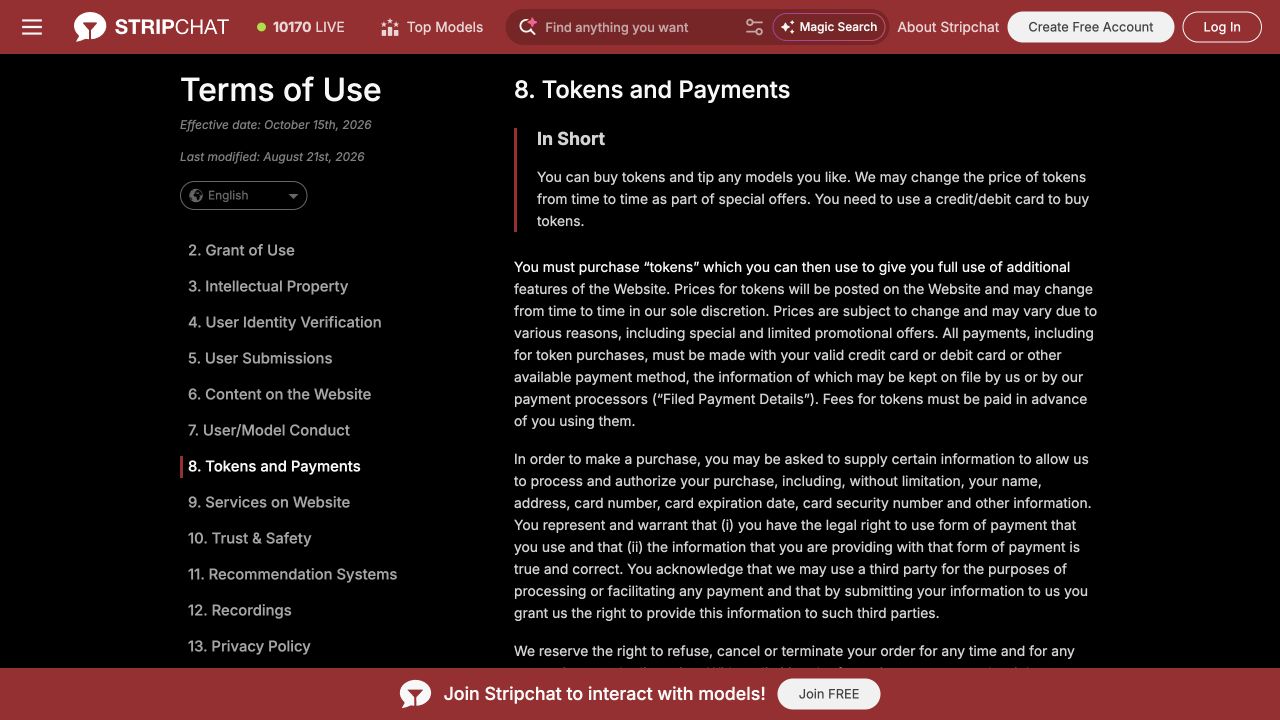
The official token-purchase guide says payment methods can vary by country. A method appearing in that guide does not establish that it will be available for your particular purchase in India. Check the options and final amount presented in your own checkout.
The terms require a valid payment method that you have the legal right to use, along with accurate information. They also allow third-party payment processing and say payment details may be retained by the platform or its processors. A stored payment method and an authorised recurring purchase are related concepts, but they are not the same thing. Understand what you are authorising when confirming a purchase or enabling a feature.
For your records, keep the package details and receipt. If a later charge looks unfamiliar, those records help distinguish a new purchase from an automatic top-up or a separate billing problem. The token total alone may not explain which payment created it.
How Auto-Refill changes your spending
Auto-Refill is an instruction to make another purchase when the balance drops below a chosen threshold. The terms say it charges the last payment details on file for an amount equivalent to the last purchase. You can opt out through account Settings.
The previous purchase matters here. If you move from a small package to a larger one, an enabled refill may repeat that larger amount. Think about the size of the next payment as well as the balance threshold. A low threshold does not necessarily mean a small charge.
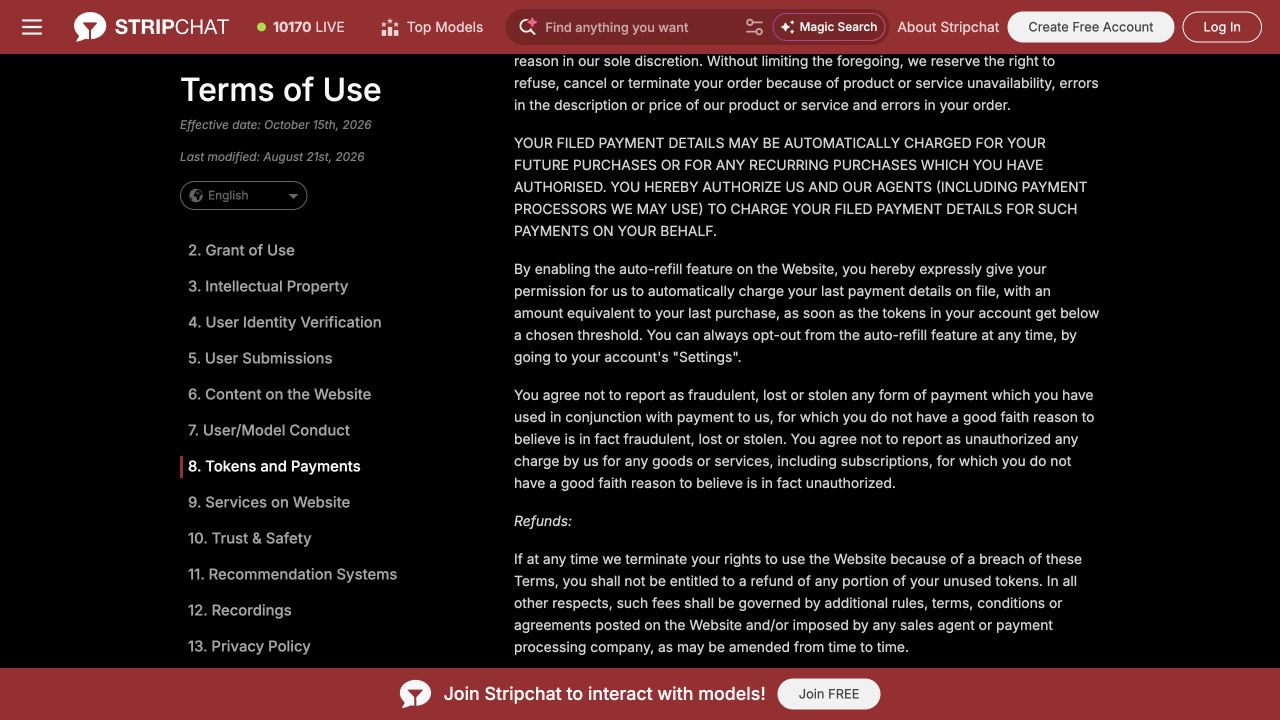
Review the setting after changing how much you buy or how often you use paid features. Turning Auto-Refill off addresses future automatic top-ups; it should not be mistaken for reversing a charge that has already been made. Keep the confirmation of a disputed payment and ask support about that transaction separately.
Paid shows, messages and the right to decline
Section 9 describes services that may charge by the second or minute against the token balance. It expressly says you need to exit the paid activity to stop its billing. If you decide a session should end, use the feature’s exit control rather than assuming that looking away or leaving the conversation idle will stop the charge.
Check the rate and the kind of session before entering. The terms describe private shows and a separate option for other users to watch without interacting. The word “private” should therefore not be read as a universal promise about every mode’s audience or recording arrangements. Understand the particular feature offered to you.
A paid message does not guarantee a response
The messenger rules allow models to set token fees based on the kind of content sent. Where a fee applies, the terms say it can be charged irrespective of whether the intended recipient receives or responds to the content. Sending several follow-ups may therefore create several charges without resolving the original question.
Before sending a paid message, check the displayed fee and decide whether the message is worth that cost on its own. Do not assume you are purchasing a guaranteed reply unless the specific offer clearly establishes that obligation.
The same section says models may decline an activity at their discretion. Spending tokens does not entitle a viewer to insist on something a model refuses. If a paid service creates a genuine complaint, address the transaction and the stated terms through support rather than pressuring the person involved.
Stripchat refunds and unused tokens
A payment refund and a restoration of tokens are different outcomes. The terms discuss discretionary token refunds for certain technical problems or a provably unsatisfactory private show. They do not promise that every complaint will produce money back to the original payment method.
The distinctions in Section 8 are useful when describing a problem:
- A website malfunction took tokens. Explain the feature, the approximate time and what happened to the balance.
- A private show was unsatisfactory. The terms say the show must be ended as soon as possible for this category of claim.
- You gave a tip. The terms treat tips as gifts and exclude them from token refunds.
- You paid to watch another person’s private show. The terms also exclude this activity from token refunds.
The dedicated Tokens Refund Policy describes a narrower situation involving tips with a clear agreement, while Section 8 uses the broader exclusion above. Our Stripchat refund guide explains that difference, the unused-package conditions and the separate complaint deadlines. Ask support which conditions apply to the specific transaction.
A disappointing interaction is therefore not interchangeable with a technical error. Describe the event accurately and keep any relevant transaction records. A refund remains subject to the relevant conditions and the outcome of the review.
What happens to a balance after suspension or inactivity?
The terms say unused tokens are not refunded when access is terminated for a breach. They also reserve the right to terminate an inactive account and state that unused tokens can then be forfeited. The inactivity clause does not give a fixed number of days or months on which you can base a deadline for returning to the account.
These provisions are a reason to consider how much balance you actually need. A larger package may be attractive for its advertised value, but unused tokens remain subject to the account rules. Do not treat them as money protected from every future account restriction.
Uploads, ownership and the licence you grant
The User Submissions section says users or their licensors retain copyright in submitted content. It also grants the platform extensive rights to use that content, including reproduction, distribution, adaptation and publication. The licence is described as worldwide, royalty-free, perpetual and non-cancellable, with sublicensing rights.
Ownership and permission to use are different things. You can retain copyright while giving another party substantial rights. A person considering an upload should read the licence before sharing material they would later want removed from every context.
The terms also say submissions cannot always be withdrawn and do not guarantee their confidentiality. Other users may be able to view or save material. Sending identifying information through a platform feature should therefore be a deliberate decision, especially when a profile or conversation can connect the account to your everyday identity.
You must have the necessary rights and consent for what you submit. A photo being available online does not establish permission to upload it, and another person’s appearance in a file raises their own rights and consent questions. Do not assume a platform will sort out those permissions on your behalf.
Recording rules do not allow general redistribution
Section 12, Recordings, describes a setting through which models may allow recordings. For users, it limits recorded shows to personal use and prohibits releasing, publishing, exhibiting or reproducing them. Paying for access does not turn a recording into content you may repost elsewhere.
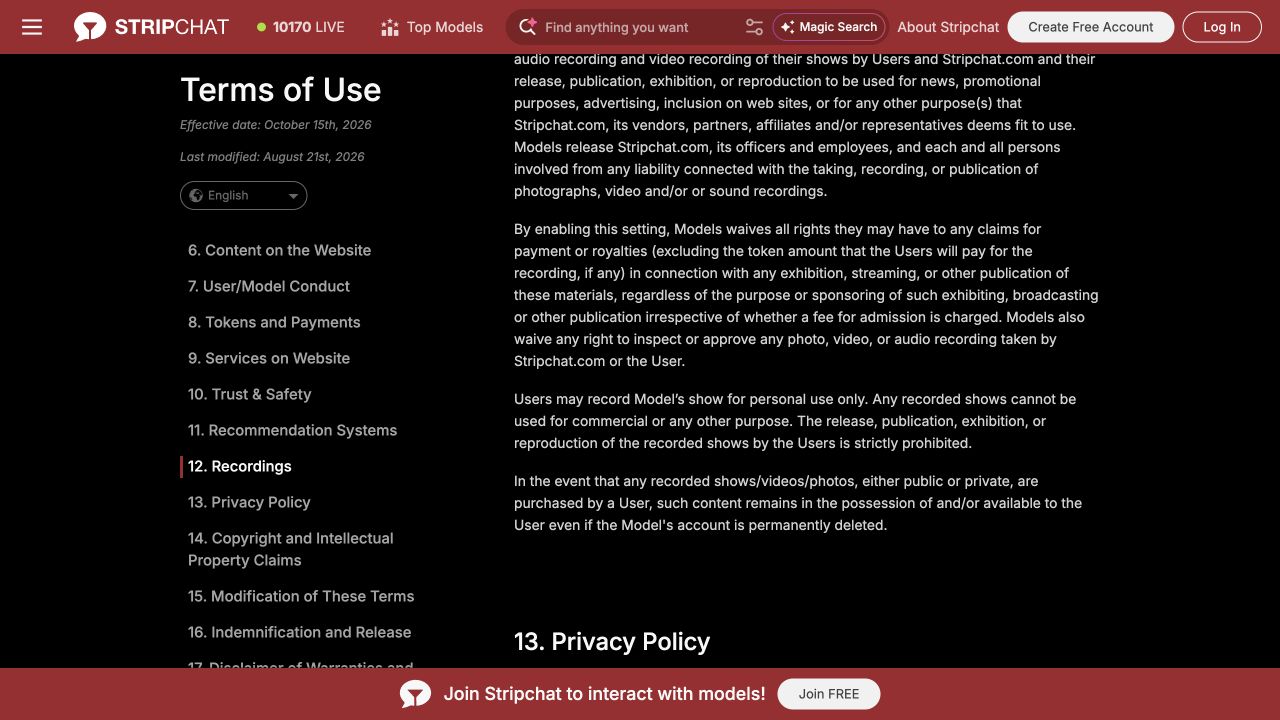
There is another detail for creators to consider: the terms say purchased recordings, videos or photos can remain in a user’s possession or available to that user after the model’s account is permanently deleted. Closing an account should not be understood as a guaranteed recall of material already purchased.
The rules also describe permissions granted to the platform and its partners when recording is enabled. Those permissions should not be confused with the narrower personal-use position of an ordinary viewer. Read the clauses that apply to your role rather than treating every party as having the same rights.
Conduct rules and account restrictions
The conduct section prohibits harassment, impersonation, unauthorised account use, unsolicited messaging, malicious software and interference with security features. It also restricts automated collection of website data. These rules apply alongside the more detailed community and content policies linked from the terms.
Access is granted on a limited basis. Section 2 reserves broad termination powers, including deactivating an account, blocking access and removing submissions. Other sections address restrictions for particular violations. A functioning login today does not promise permanent access to every feature or guarantee that a moderation decision will follow one fixed sequence of warnings.
The terms also authorise monitoring, recording and logging of activity, including chats, messages and streams. A conversation being private from other ordinary users does not mean it is excluded from platform moderation or records. This is relevant both to what you share and to what may help identify a reported incident.
If your access is restricted, keep the notice and ask which rule or event the decision concerns. Use the official support route to request clarification or review. The terms prohibit attempting to use the service after termination; creating another route into the site is not a substitute for resolving the restriction.
Complaints, disputes and changes to the rules
Start a payment complaint with the transaction facts. Stripchat’s billing-support instructions ask for the purchase date, time and amount, plus a receipt if available. Explain whether the issue is a missing purchase, an unexpected top-up or tokens spent by a particular feature. That is more useful than reporting only that the balance looks wrong.
The payment terms prohibit falsely describing a genuine authorised purchase as fraud. They expressly refer to whether there is a good-faith reason for the report. This should not be read as an instruction to ignore an actually unauthorised charge. Describe what you know accurately when contacting the platform or your bank.
For content or conduct complaints, the terms link to reporting mechanisms and distinguish processes for people inside and outside the EEA. If you are in India, check the route specified for your location before relying on an EEA-specific procedure.
What the arbitration and liability clauses say
Section 18 provides for arbitration seated in Cyprus under the specified rules. Section 19 also contains governing-law and court-jurisdiction provisions. The document therefore addresses both arbitration and court jurisdiction. Neither clause promises that a support request will resolve the dispute.
The document contains broad warranty exclusions and liability limitations, including a stated maximum liability of US$100. That figure is a contractual limitation, not a compensation promise or a guaranteed refund. The terms themselves recognise that some exclusions or limitations may not apply in every jurisdiction. Their enforceability in a particular dispute requires consideration of applicable law and the facts.
Do rule changes require an email?
Section 15 says amended terms may be posted on the website without another notification and treats continued use as acceptance of the amendments. The privacy-policy section has similar wording about changes. Do not rely entirely on an inbox notification to discover a new condition.
Before a significant purchase or a change in how you use the service, revisit the relevant clauses. Keeping the receipt, any displayed offer and the terms relevant to that decision can make a later disagreement easier to describe.
Frequently asked questions
Can Stripchat charge automatically after a token purchase?
The terms allow authorised future or recurring purchases using payment details on file. Auto-Refill is one example: when enabled, it uses the selected balance threshold and the last purchase amount. Check the arrangement you enabled rather than assuming every purchase has the same billing settings.
Does a tip guarantee a particular performance?
No. The terms allow a model to decline an activity and treat tips as gifts excluded from token refunds. Read the conditions of a paid feature before spending, and do not treat a tip as permission to demand an activity.
Are unused tokens always safe if I stop using the account?
No. The terms contain forfeiture provisions linked to termination for a breach and to an inactive account being terminated. The clause does not specify a fixed inactivity period.
Do I lose copyright when I upload content?
The terms say you or your licensor retain copyright, while granting broad usage rights to the platform. Retaining ownership does not cancel that licence or guarantee that every submission can later be withdrawn.
Can I post a purchased recording on another website?
The recording clause restricts user recordings to personal use and prohibits publication and reproduction. A purchase does not provide a general redistribution licence.
Are the platform’s terms a statement that every use is legal in India?
No. The eligibility clause requires compliance with applicable law. Account approval, a payment option or a recording feature does not settle the separate legal questions raised by your activity.